 Ask Bookolatha
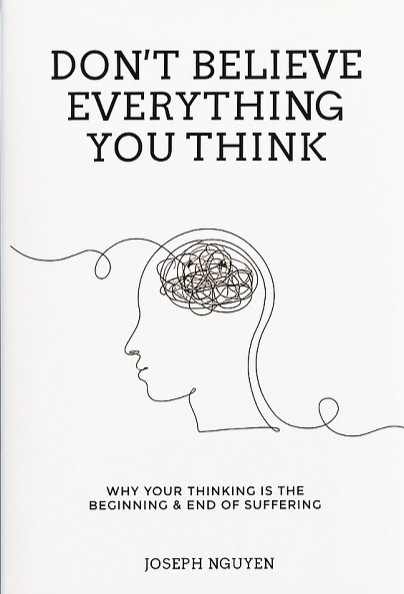
Click to enlarge
Don't Believe Everything You Think
Tags
In Stock
In stock: 2-5 days delivery
Ask about this book
Not sure if it's right for you?
Ask our assistant anything about Don't Believe Everything You Think.
Answers are AI-generated from this book's details and may not be perfect.
In an era where the noise of self-help promises and productivity hacks grows ever louder, Joseph Nguyen's Don't Believe Everything You Think arrives as a quiet revolution. It offers not another set of techniques to optimize your mindset, but a radical invitation to examine the very nature of thought itself. The book's core premise is deceptively simple: the root of nearly all human suffering, from anxiety and depression to relational conflict and existential dread, does not lie in external circumstances. It lies in our unquestioned, automatic belief in the thoughts that pass through our minds. This is not a book about learning to think more positively or to reprogram your subconscious with affirmations. Instead, it is a profound exploration of the difference between thinking and being aware of thinking, and the peace that becomes available when you stop identifying with the endless stream of mental chatter.
Nguyen builds his argument on the fundamental insight that we are not our thoughts. Thoughts are temporary events in consciousness, like clouds drifting across a clear sky. They are not reality; they are merely interpretations, memories, projections, and judgments. The suffering begins when we fuse with these thoughts, taking them as absolute truth. Nguyen describes how we live inside a self-constructed prison of narratives about the past, fears about the future, evaluations of ourselves, and assumptions about others. This mental noise, which he calls the thinking mind, is the engine of all psychological pain. The book systematically dissects common thought traps: catastrophizing, where we assume the worst possible outcome; personalization, where we believe everything is about us; black-and-white thinking, where we see only extremes; and the endless loop of rumination that replays past grievances or worries. Learning to recognize these patterns is the first step toward freedom.
A crucial distinction Nguyen makes is between thinking and awareness. Thinking is the content the stories, the evaluations, the internal monologue. Awareness is the space in which thought appears. Just as you can observe a passing car without being in it, you can observe a thought without being consumed by it. The path to freedom is learning to rest in that aware space, to become the witness of your mind rather than its captive. Nguyen emphasizes that the goal is not to stop thinking an impossible feat but to change your relationship with thought. He introduces the practice of simply noticing thoughts without following them, judging them, or trying to change them. This act of observation creates a gap between you, the observer, and the thought itself. In that gap, the thought loses its emotional charge and its apparent solidity. What remains is a sense of peace, clarity, and presence that was always there, hidden beneath the noise.
Why does this matter? Because when you do not believe a stressful thought, you are left with peace. Nguyen guides readers to question their most painful beliefs with simple yet powerful inquiries: Is this thought absolutely true? Can I be 100 percent certain? How do I feel when I believe this thought? Who would I be without this thought? These questions are not meant to be answered intellectually but to be used as tools for direct investigation. They help to pry open the grip of core beliefs that cause lasting suffering. For instance, a thought like I am not good enough can be held lightly rather than believed as an immutable fact. When you see that this thought is not absolutely true, a sense of relief and space arises. You are no longer defined by it.
Nguyen also delves into the nature of the self or ego. He describes the ego as a collection of identified thoughts and stories a mental construct that feels separate, vulnerable, and in need of protection. Much of our thinking is the ego's attempt to defend its image, seek validation, or gain control. By seeing the ego for what it is a mere appearance in awareness we can stop taking its incessant demands so personally. This leads to a natural reduction in defensiveness, comparison, and the need for external approval. The grip of social anxiety, performance pressure, and self-doubt begins to loosen.
The latter chapters of the book explore the positive outcomes of this mental shift. As attachment to thought decreases, you naturally experience more presence the ability to fully engage with the current moment without mental commentary. Creativity and intuition, often stifled by overthinking, begin to flow freely. Decision-making becomes clearer because it arises from inner stillness rather than fear-based analysis. Relationships improve as you listen to others without the filter of your own internal dialogue and judgments. Life becomes less about managing problems and more about experiencing what is, with a sense of wonder and ease.
The beauty of Nguyen's approach is that it requires no lifelong practice or complex system. It is a direct pointing to the truth that peace is your natural state, obscured only by the belief in your thoughts. The book is written in a conversational, accessible style, making profound spiritual principles understandable to anyone. It bridges the gap between ancient wisdom traditions, such as Advaita and Taoism, and modern psychological insights, offering a universal path to freedom from the mind.
For readers in Sri Lanka seeking a genuine transformation in how they relate to their own minds, Don't Believe Everything You Think is available at Bookolog, your trusted online bookstore. Bookolog offers fast delivery across Sri Lanka, making it easy to bring this life-changing book into your hands. Whether you are struggling with chronic overthinking, seeking a deeper spiritual understanding, or simply curious about the nature of consciousness, this book offers a clear and compassionate guide to the peace that lies beyond thought. It is a book to be read slowly, savored, and returned to again and again, as each reading reveals new layers of insight. The journey Nguyen invites you on is not about becoming someone different, but about discovering who you already are underneath all the stories.
Key Takeaways
- Discover that you are not your thoughts and can observe them without being controlled.
- Learn a straightforward method to question painful beliefs and find unexpected peace.
- Understand how the thinking mind creates suffering and how to step out of its grip.
- See the difference between thinking and awareness, and rest in the space between thoughts.
- Gain practical insight for reducing anxiety by changing your relationship with your own mind.
Customer feedback
Reviews & Service Ratings
See what readers say about this book and our service.
Service rating
0.0/5
Please sign in to leave a review and rate our service.
No reviews yet. Be the first to rate this book and our service.
You Might Also Like
Browse All
Products You May Like
Shop All




Bookolatha
Online · Bookolog assistant
Bookolatha is grounded in our catalogue and store info. Answers may not be perfect.