
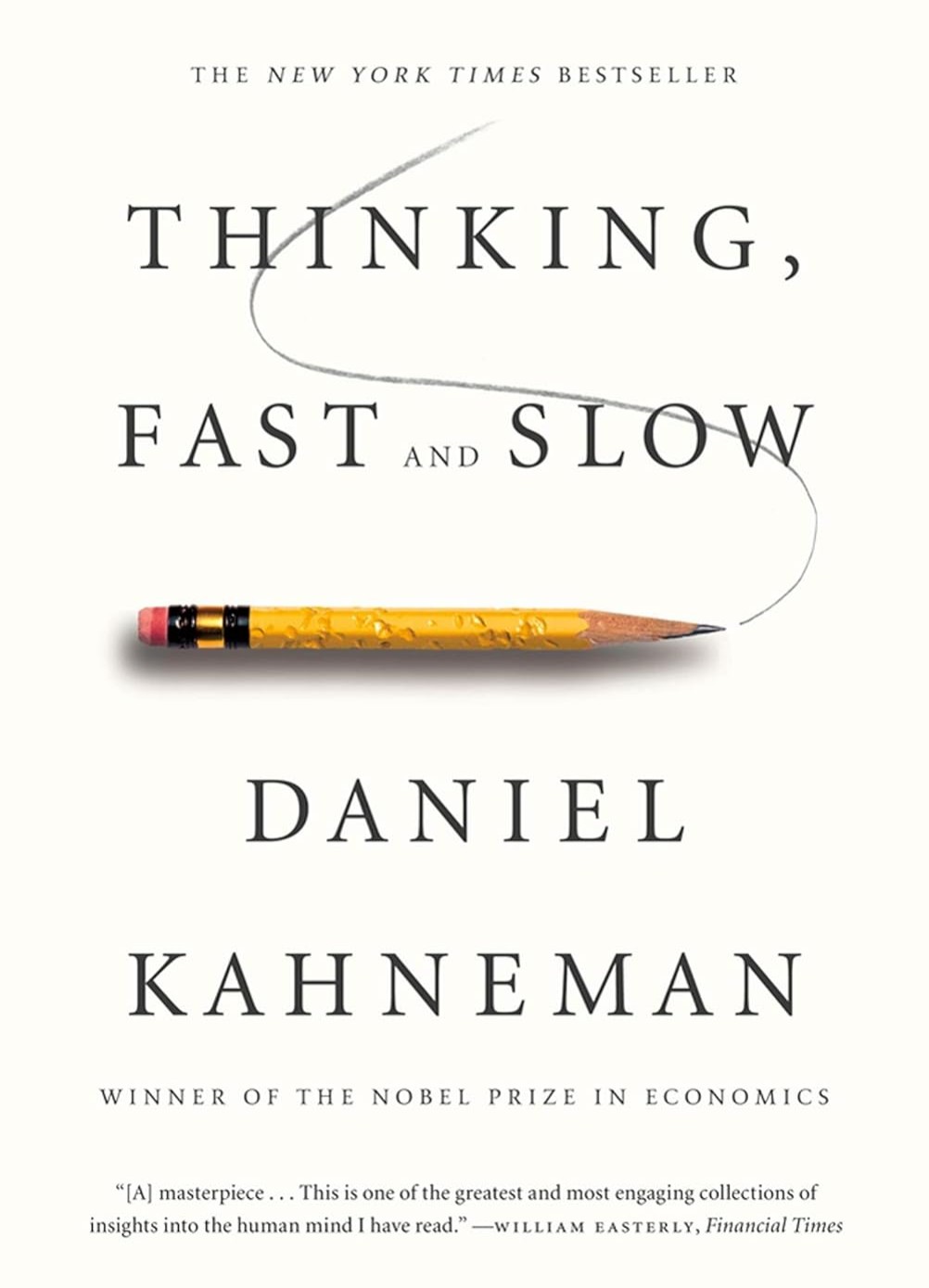
Click to enlarge
Thinking, Fast and Slow
Tags
Out of Stock
Currently unavailable
Currently unavailable: let us help you find it
Ask about this book
Not sure if it's right for you?
Ask our assistant anything about Thinking, Fast and Slow.
Answers are AI-generated from this book's details and may not be perfect.
In his landmark work, Thinking, Fast and Slow, Nobel Prize-winning psychologist Daniel Kahneman offers a masterful exploration of the two systems that drive human thought: the fast, intuitive System 1 and the slow, deliberate System 2. Drawing on decades of groundbreaking research in behavioral economics, Kahneman reveals how these systems shape our decisions, from mundane choices to high-stakes judgments. This book is a transformative journey that uncovers the hidden biases and mental shortcuts that often lead us astray, empowering readers to recognize when to trust intuition and when to engage critical thinking.
System 1 operates effortlessly and automatically, handling routine tasks like recognizing faces or detecting threats in a split second. It is emotional, associative, and prone to systematic errors. System 2, on the other hand, demands effort and attention, handling complex calculations and logical reasoning. Kahneman explains how these systems interact, often producing surprising outcomes. For instance, solving 12 x 17 requires System 2 to override System 1's approximate answer. This dynamic tension between speed and accuracy lies at the heart of cognition, and the book provides compelling examples of how our minds can be tripped up by simple mental exercises, such as the famous Linda problem illustrating the conjunction fallacy.
The heart of the book is its detailed examination of cognitive biases and heuristics that System 1 relies on. Kahneman and his collaborator Amos Tversky uncovered a rich catalog of these patterns. The availability heuristic makes us overestimate the likelihood of vivid events, like plane crashes versus car accidents. Anchoring shows how initial numbers influence our judgments. Confirmation bias leads us to seek evidence that supports our beliefs, ignoring contradictions. The planning fallacy causes us to underestimate time and resources needed for projects. Loss aversion makes us fear losses more than we value equivalent gains, often leading to irrational decisions. The peak-end rule reveals that we judge experiences based on their most intense moment and ending, not their duration. Understanding these biases helps readers spot when their intuition might mislead them.
The implications of Kahneman's work extend far beyond the lab. In business, overconfidence leads executives to overestimate market predictions. In finance, loss aversion can cause holding onto losing investments too long. In public policy, insights from the book have informed 'nudge' initiatives that help citizens make better choices, such as simplifying retirement savings enrollment. The book also tackles the psychology of happiness, showing how memories are shaped by the peak-end rule, with implications for designing vacations or medical procedures. Kahneman's writing is a model of clarity, weaving experiments, anecdotes, and philosophical reflections into a seamless narrative. The book is structured in five parts, from the mechanics of the two systems to heuristics and biases, overconfidence, framing of choices, and well-being. Each chapter builds on the last, creating an immersive experience that feels like a conversation with a wise mentor.
Since its publication, Thinking, Fast and Slow has earned global acclaim, including a place on The New York Times Book Review's list of the ten best books of 2011, the National Academy of Sciences Best Book Award, and the Los Angeles Times Book Prize. It has influenced fields from economics to medicine, law, and education. For readers in Sri Lanka, this book offers invaluable insights that can be applied to everyday decision-making, whether navigating local markets, planning family budgets, or understanding social behavior. The principles are universal, yet they gain special resonance in a society like Sri Lanka's, where information overload and cultural expectations create unique decision-making challenges.
At Bookolog, we are passionate about bringing transformative reads to Sri Lankan readers. We stock a carefully curated selection of books that inspire and educate, and Thinking, Fast and Slow is a cornerstone of our psychology and self-improvement collection. When you buy this book from Bookolog, you are investing in a deeper understanding of yourself and the world around you. Our customers appreciate high-quality service, fast delivery across the island, and the personalized touch that makes Bookolog more than just an online bookstore. Whether you are a student of behavioral economics, a business professional seeking a competitive edge, or simply a curious mind, this book is an essential addition to your library. Order your copy today and embark on a journey that will change the way you think about thinking.
Key Takeaways
- Understanding System 1 and System 2 helps you recognize when your intuition might lead you astray.
- This book reveals the hidden biases that affect your everyday decisions, from shopping to investing.
- Kahneman explains why we're overconfident in our predictions and how to slow down for better judgments.
- You'll learn practical ways to spot cognitive traps and make more deliberate, thoughtful choices.
- A fascinating look at how our minds work, offering tools to improve decision-making in both life and work.
Customer feedback
Reviews & Service Ratings
See what readers say about this book and our service.
Service rating
0.0/5
Please sign in to leave a review and rate our service.
No reviews yet. Be the first to rate this book and our service.
You Might Also Like
Browse All





Products You May Like
Shop All




Bookolatha
Online · Bookolog assistant
Chat history
This chat stays available while you browse.
Log in to save and revisit multiple conversations.
Log in →Bookolatha is grounded in our catalogue and store info. Answers may not be perfect.