 Ask Bookolatha
Click to enlarge
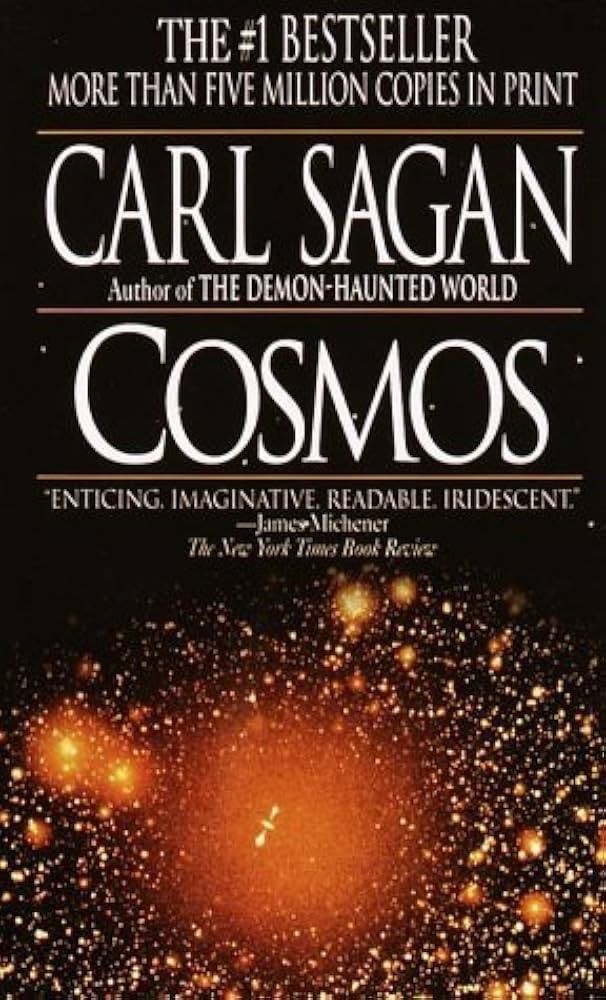
Cosmos
Tags
Out of Stock
Currently unavailable
Currently Unavailable
This book is out of stock
Ask about this book
Not sure if it's right for you?
Ask our assistant anything about Cosmos.
Answers are AI-generated from this book's details and may not be perfect.
In the pantheon of popular science, few works achieve the luminous resonance of Carl Sagan's Cosmos. First published in 1980 as the companion to his landmark television series, this book transcends genre to become a philosophical meditation, a scientific primer, and a poetic invocation of wonder. Sagan blends rigorous intellect with lyrical prose, inviting readers to step outside human history and gaze upon the vast drama of the universe. From the first sentence, he establishes awe and humility: "The cosmos is all that is or ever was or ever will be." This is a love letter to the universe and a call to arms for reason and curiosity. Available now at Bookolog in Sri Lanka, this edition brings Sagan's timeless vision to a new generation of explorers.
Sagan structures the narrative around the cosmic calendar, compressing the 13.8-billion-year history of the universe into a single year. The Big Bang occurs on January 1, the Milky Way forms in May, life emerges in October, and all of recorded history occupies the last ten seconds of December 31. This simple framework forces a profound emotional reorientation, making every fact resonate with perspective. From this foundation, Sagan launches into interconnected essays on the birth of stars, the formation of planets, and the evolution of life. He explains how stars fuse hydrogen into helium and die in supernovae that scatter heavy elements across the galaxy. The atoms of our bodies were forged in the hearts of long-dead stars: we are literally star-stuff, children of the cosmos. Sagan does not just teach us about the universe; he teaches us how to belong to it.
The chapter on the solar system is a miniature epic. Sagan takes readers from the scorched plains of Mercury to the frozen methane lakes of Titan, describing volcanoes of Io and mysterious storms on Saturn. Yet his focus always returns to Earth, the only known haven for life. He warns of nuclear winter and environmental fragility, warnings written during the Cold War that have only grown more urgent. For Sri Lankan readers, where biodiversity and nature face constant threat, Sagan's call to cherish our planetary home resonates with particular force. The book also celebrates the history of scientific thought, telling stories of Hypatia, Kepler, and Giordano Bruno, who was burned for suggesting an infinite universe. These narratives show that science advances through imagination and the courage to challenge authority, a lesson vital in our age of misinformation.
Sagan makes an extended argument for extraterrestrial life, exploring the chemistry of carbon and water, the Drake Equation, and the Fermi Paradox. He is optimistic but not naive, insisting the search is worth the scientific and philosophical dividends. Throughout, he returns to the theme of scale. The Voyager spacecraft's Pale Blue Dot photograph shows Earth as a solitary pixel in a beam of sunlight. That image encapsulates the core message: we are all inhabitants of a single fragile world. Our divisions become meaningless; the only identity that matters is that of a species, a steward of our tiny planet. In Sri Lanka, a nation that has weathered civil war and natural disasters, this message of unity and foresight is particularly timely.
The second half of Cosmos explores the nature of life: DNA, the machinery of cells, and the evolution of consciousness. Sagan describes the double helix as a kind of cosmic memory. He believes intelligence, if it can survive its own destructive tendencies, is the most precious phenomenon in the known universe. Our consciousness is the universe's way of knowing itself. Sagan's writing is clear and accessible, making complex ideas understandable without oversimplification. The book has remained in print for over four decades, speaking to a universal longing to know where we come from and where we are going. For educators, students, and lifelong learners in Sri Lanka, Cosmos provides a foundation for understanding our place in the cosmos. Bookolog is dedicated to supporting that journey.
The emotional mood of Cosmos is profound wonder mixed with sober responsibility. Sagan balances the dark side of human nature with unwavering faith in the power of reason and the beauty of the natural world. In the final chapters, he calls for a planetary perspective that transcends national boundaries, arguing that only global cooperation and reverence for life can ensure a sustainable future. These words are more urgent than ever in the face of climate change. For Sri Lanka, a country of resilience and a desire for peace, Sagan's vision offers a blueprint for an enlightened future. By reading Cosmos, you join a global community of dreamers and doers. At Bookolog, we are proud to make this transformative book available across Sri Lanka. Order your copy today and let Carl Sagan be your guide to the stars.
Key Takeaways
- The universe is vast and ancient, and our place in it is both humbling and awe-inspiring.
- Science is a tool that reveals the beauty of nature, but it also demands critical thinking and skepticism.
- We are all made of stardust—a literal connection to the cosmos that binds every living thing.
- The search for extraterrestrial intelligence is not just about aliens; it's about understanding ourselves.
- Humanity's future depends on our ability to cherish our planet and explore the universe with wonder and responsibility.
Customer feedback
Reviews & Service Ratings
See what readers say about this book and our service.
Service rating
0.0/5
Please sign in to leave a review and rate our service.
No reviews yet. Be the first to rate this book and our service.
You Might Also Like
Browse All

Products You May Like
Shop All



Bookolatha
Online · Bookolog assistant
Bookolatha is grounded in our catalogue and store info. Answers may not be perfect.