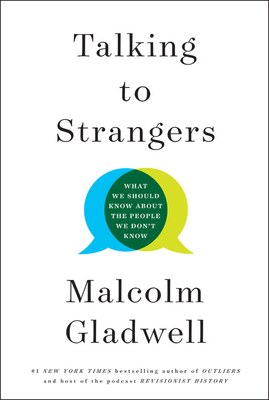
Click to enlarge
Talking to Strangers
Tags
Out of Stock
Currently unavailable
Currently Unavailable
This book is out of stock
Talking to Strangers is a masterful exploration of the human tendency to misjudge strangers and the devastating consequences that often follow. Malcolm Gladwell draws on a wealth of real-life stories, psychological studies, and historical events to uncover why we are so bad at understanding people we don't know.
The book opens with the case of Sandra Bland, a woman who died in police custody after a routine traffic stop escalated inexplicably. Gladwell uses this tragedy to pose a fundamental question: Why do we so often fail to accurately read strangers? He argues that our default assumption is that people are truthful, a concept he calls the 'truth-default theory.' This assumption, while necessary for social functioning, leaves us vulnerable to deception and misinterpretation.
Gladwell then takes readers on a journey through various realms where stranger interactions go awry: from spycraft (the case of Cuban double agent Ana Montes) to campus sexual assault (the Brock Turner case) to the financial crisis (Bernie Madoff's Ponzi scheme). Each story illustrates how our tools for judging others—facial expressions, body language, previous behavior—are often flawed or misinterpreted.
A key insight Gladwell presents is the phenomenon of 'coupling,' the idea that behavior is often tied to specific contexts rather than character. For example, suicide is not just about an individual's despair but also about the availability of a particular means. This challenges our tendency to attribute actions solely to personality.
The book also explores the concept of 'default to truth' and how it can be exploited by those who are skilled liars. Gladwell discusses why transparency—the belief that people's inner states are outwardly visible—often fails. He points to research showing that we are not as good at detecting lies as we think, and that overconfidence in our lie-detection abilities can lead to tragic misjudgments.
Talking to Strangers is not just a critique of our failures; it also offers a path forward. Gladwell suggests that we should reconsider our reliance on quick judgments and instead adopt more humility and curiosity when dealing with strangers. He advocates for what he calls 'the power of the positive'—the idea that giving people the benefit of the doubt is not naive but a necessary social lubricant, provided we also build systems (like legal safeguards) to protect against deception.
The writing is engaging and accessible, blending narrative journalism with social science in a way that keeps readers turning pages. Gladwell's signature style—short chapters, compelling anecdotes, and surprising connections—makes complex ideas digestible. Each chapter builds on the last, culminating in a powerful conclusion about the limits of human understanding.
For anyone interested in psychology, sociology, or simply making better sense of the world, Talking to Strangers is indispensable. It will change the way you think about your interactions with everyone from colleagues to neighbors to strangers on the street. It is a timely reminder that, in a world increasingly divided, learning to talk to strangers is more important than ever.
This book has been widely praised for its provocative arguments and has sparked discussions in book clubs, classrooms, and boardrooms. It is a New York Times bestseller and has been translated into multiple languages. Whether you are a longtime Gladwell fan or new to his work, Talking to Strangers will challenge your assumptions and leave you with a deeper understanding of human nature.
Key Takeaways
- Understanding the 'truth-default theory' helps explain why we are so often deceived by strangers we interact with daily.
- The concept of 'coupling' reveals that people’s behavior is often tied to specific situations rather than fixed character traits.
- Our reliance on facial expressions and body language to judge truthfulness is largely misguided and can lead to dangerous errors.
- Transparency—the belief that inner thoughts are reliably visible—is a myth; we need to approach strangers with more humility and curiosity.
- Building better systems, not just better instincts, is key to reducing the tragic consequences of misjudging strangers.
Customer feedback
Reviews & Service Ratings
See what readers say about this book and our service.
Service rating
0.0/5
Please sign in to leave a review and rate our service.
No reviews yet. Be the first to rate this book and our service.