
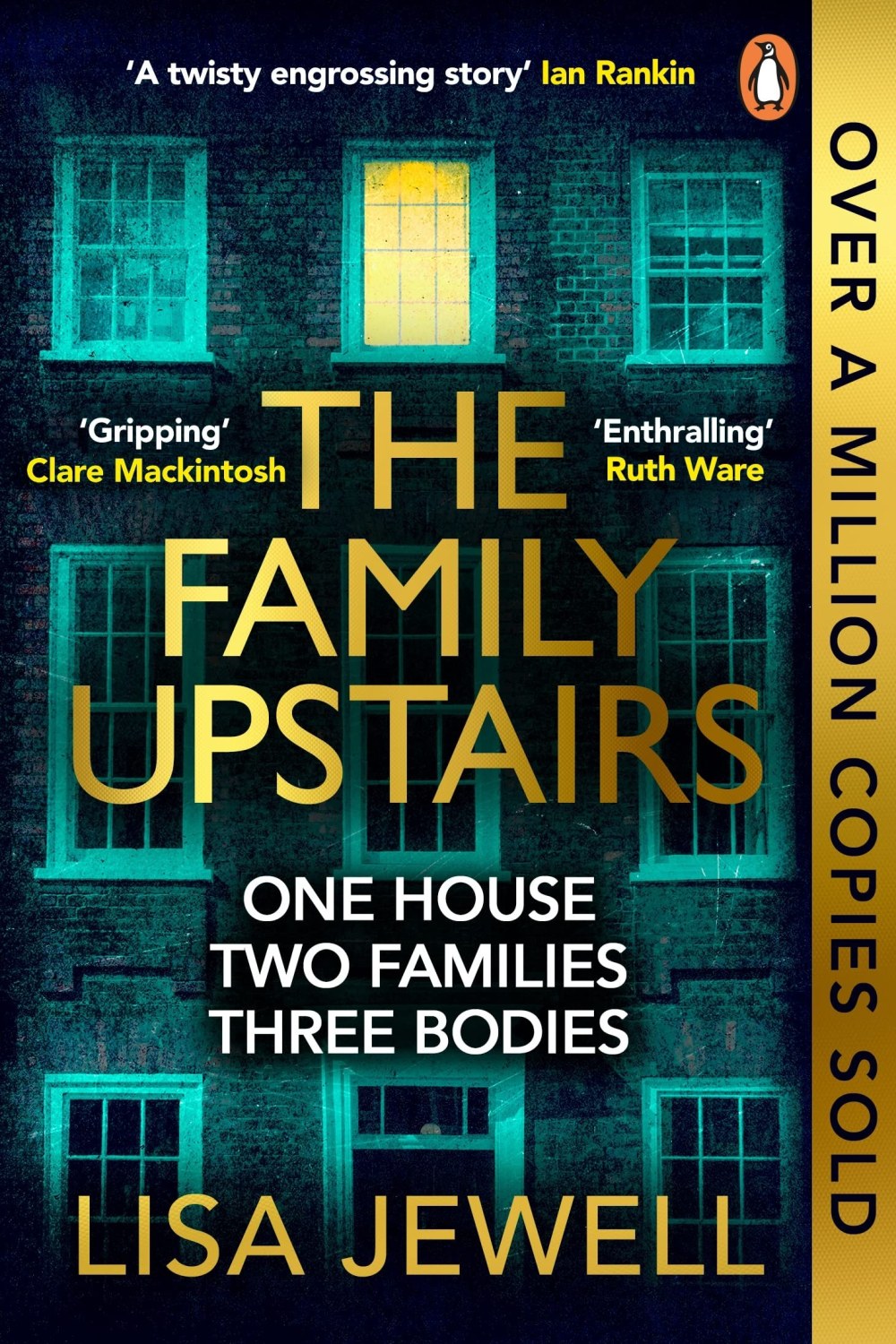
Click to enlarge
The Family Upstairs
Tags
Out of Stock
Currently unavailable
Currently unavailable: let us help you find it
Ask about this book
Not sure if it's right for you?
Ask our assistant anything about The Family Upstairs.
Answers are AI-generated from this book's details and may not be perfect.
In The Family Upstairs, Lisa Jewell delivers a masterfully crafted psychological thriller that burrows deep into the darkness of family secrets and the fragility of trust. The novel opens on the day twenty-five-year-old Libby Jones discovers she has inherited a magnificent, long-abandoned mansion in one of London's most exclusive postcodes. The house at 16 Cheyne Walk has been the stuff of local legend for decades: a dilapidated Georgian townhouse with boarded-up windows and a garden overgrown with weeds, its silence a stark contrast to the vibrant life it once held. For Libby, who was adopted as a baby and has always wondered about her origins, this inheritance is a doorway to the past she never knew.
The bequest comes with a letter from the solicitors, stating that the property was left to her by a biological mother she never met. But as Libby begins to explore the decaying house, she uncovers a chilling history that has haunted the neighborhood for twenty-five years. In 1990, the bodies of a wealthy couple, Henry and Martina Lamb, were found in the kitchen, dead from apparent suicide-murder. The three children of the household - Henry (then ten), Lucy (fourteen), and a baby girl named Serenity - had vanished without a trace. The only clue left behind was a note written by the eldest daughter: "Sorry, we had to go. We had to leave." The police and media were baffled, and the case grew cold, but the mystery never died.
As Libby delves deeper, she learns that her biological family was not what it seemed. The Lambs were a wealthy, successful family, but their lives were shattered when a charismatic drifter named David Thomsen entered their home and slowly, insidiously, took over their lives. David was a leader of a small cult, a man with an irresistible charm that masked a sociopathic need for control. Under his influence, the Lamb family became prisoners in their own home, their identities eroded, their wills broken. The narrative masterfully alternates between Libby's present-day investigation and the harrowing firsthand accounts of the past, told through the voices of the surviving children - Henry, Lucy, and the mysterious baby who was kept hidden away, described only as "the family upstairs."
Jewell's skill lies in her ability to create a claustrophobic, suffocating atmosphere that mirrors the psychological entrapment of the Lamb family. The house itself becomes a character, its crumbling walls and hidden rooms holding secrets that slowly emerge. The cult leader David is both terrifying and fascinating, a figure who preys on the vulnerabilities of others with an expert touch. The family's slow descent into madness is rendered with chilling precision, showing how trust can be weaponized, and how love can be twisted into a cage. The themes of identity and belonging resonate deeply: Libby is searching not only for the truth of what happened but also for her own place in a story that predates her birth. Every discovery challenges her understanding of who she is, and each revelation is layered with moral ambiguity.
At the heart of the novel is Libby Jones, a young woman who has always felt a piece of herself was missing. Adopted at birth by loving parents, she grew up knowing she was wanted but never quite feeling complete. The inheritance of the Cheyne Walk mansion is both a gift and a curse: it offers her a connection to her biological roots, but it also plunges her into a nightmare of lies and violence. As she sifts through the remnants of the Lamb family's life - old photographs, letters hidden in floorboards, a child's drawing taped to the wall - Libby begins to piece together a portrait of a family that was slowly devoured from within. Her journey is not just about solving a cold case; it is about reclaiming a past that has been deliberately erased. Jewell handles Libby's emotional arc with sensitivity, allowing the reader to feel her confusion, her anger, and ultimately her determination to know the truth, no matter how painful.
The cult storyline is one of the most compelling aspects of The Family Upstairs. David Thomsen is a master manipulator, a man who understands human weakness and exploits it ruthlessly. He arrives at the Lamb home seemingly as a helping hand, a friendly drifter who offers to do repairs and odd jobs. Gradually, he insinuates himself into the family's daily life, using a combination of flattery, intimidation, and isolation to erode their defenses. He preys on the mother, Martina, who is already vulnerable, and he worms his way into the trust of the children. The process is insidious and terrifying, rendered with such realism that the reader can almost feel the walls closing in. Jewell does not sensationalize the cult; instead, she shows how ordinary people can be drawn into extraordinary darkness when they are isolated and desperate for connection.
The novel also shines a light on the resilience of children. Henry and Lucy, the older siblings, are forced to grow up far too fast. They must navigate a world where the adults have become puppets of a madman. Henry, in particular, is a heartbreaking figure: a boy who tries to protect his baby sister but is powerless against the tide. His adult perspective, revealed through letters and interviews, is filled with regret and a deep need to understand what happened. Lucy, strong-willed and resourceful, becomes the anchor for the family, but even she cannot escape unscathed. Their stories give the novel its emotional weight, grounding the suspense in authentic human suffering. The mystery of the baby - "the family upstairs" - adds another layer of intrigue, keeping the answers tantalizingly out of reach until the very end. The tie between Libby and the baby is one of the most shocking revelations, recontextualizing everything the reader thought they knew.
Jewell's prose is both elegant and accessible, making complex emotions and dark themes approachable without sacrificing depth. The dialogue is natural, the internal monologues revealing. She has a gift for creating tension that builds slowly, using mundane details - a creaking floorboard, a locked door, a whispered conversation - to ratchet up the dread. The book is structured like a puzzle, with pieces scattered across time and perspective. The reader is an active participant, trying to fit the clues together alongside Libby. This immersive quality, combined with vivid sensory details that bring the dilapidated mansion to life, makes The Family Upstairs a compelling read for anyone who enjoys character-driven thrillers. Fans of Gone Girl, The Silent Patient, or The Girl on the Train will find themselves enthralled by Jewell's intricate plotting and emotional depth, and the exploration of cult dynamics gives it a unique flavor reminiscent of The Girls by Emma Cline or We Need to Talk About Kevin by Lionel Shriver, but with a distinctly British sensibility.
For the Sri Lankan market, Bookolog is proud to offer this exceptional novel to readers who seek high-quality international fiction. Whether you are looking for a gripping read for your commute, a book that will keep you up at night, or a gift for a friend who loves mysteries, The Family Upstairs is an ideal choice. The universal themes of family secrets and the search for identity transcend borders, making it a story that resonates with readers everywhere. Available now at Bookolog, your premier online bookstore in Sri Lanka, this is a must-have for anyone who appreciates well-crafted suspense and unforgettable characters. Order your copy today and experience a thriller that will haunt your thoughts and deepen your understanding of the thin line between love and obsession.
Key Takeaways
- Understand how a charismatic cult leader can slowly dismantle a family’s trust and sanity.
- Experience the haunting power of hidden memories and the trauma they leave behind across generations.
- Discover the shocking truth behind a decades-old mystery through alternating timelines and multiple perspectives.
- Reflect on the meaning of family, identity, and whether blood ties can ever truly be broken.
- Feel the suspense build with each chapter as layers of deception are peeled away in a mansion full of secrets.
Customer feedback
Reviews & Service Ratings
See what readers say about this book and our service.
Service rating
0.0/5
Please sign in to leave a review and rate our service.
No reviews yet. Be the first to rate this book and our service.
You Might Also Like
Browse All



Products You May Like
Shop All




Bookolatha
Online · Bookolog assistant
Chat history
This chat stays available while you browse.
Log in to save and revisit multiple conversations.
Log in →Bookolatha is grounded in our catalogue and store info. Answers may not be perfect.