
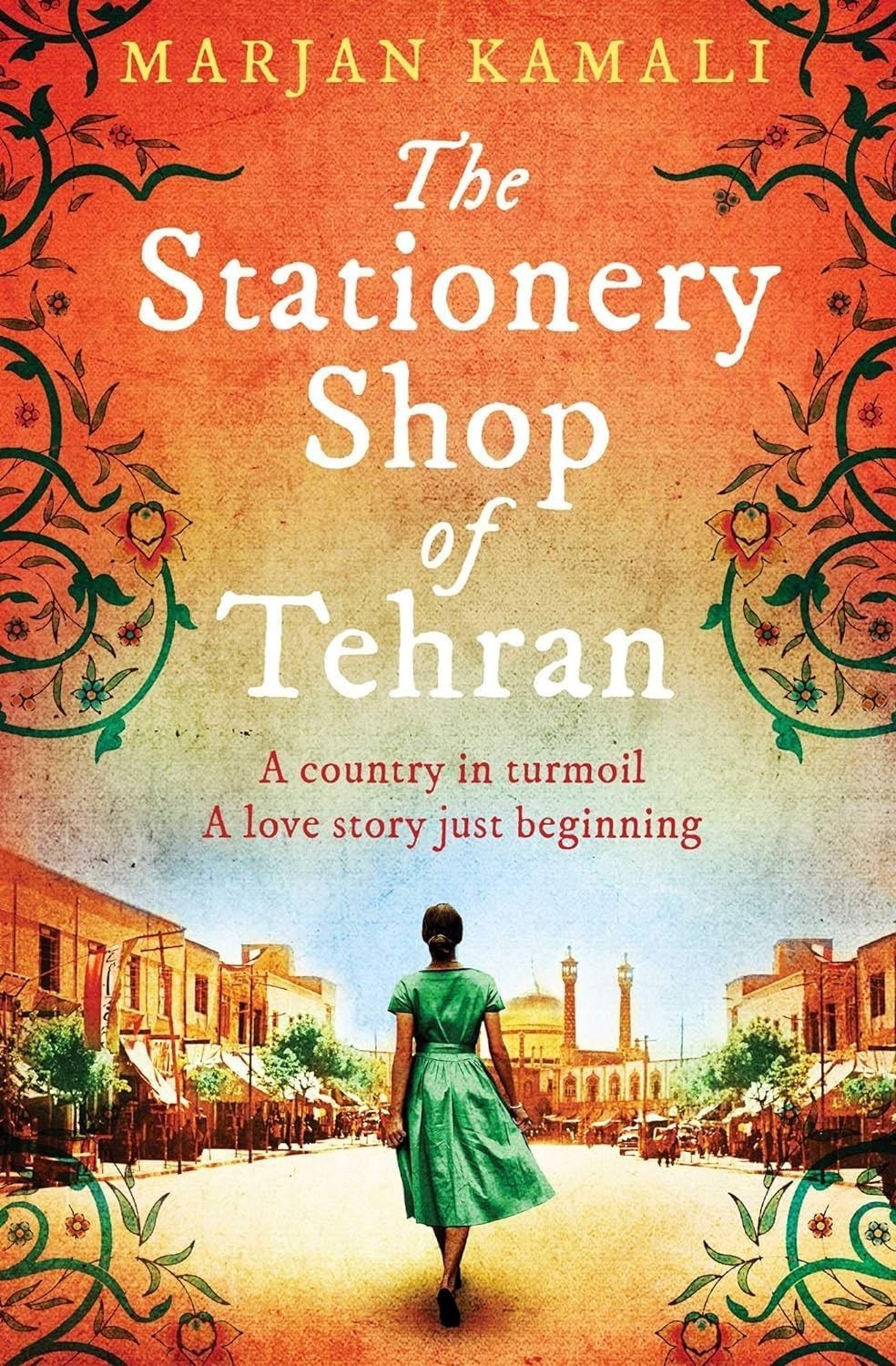
Click to enlarge
The Stationery Shop of Tehran
Tags
Out of Stock
Currently unavailable
Currently unavailable: let us help you find it
Ask about this book
Not sure if it's right for you?
Ask our assistant anything about The Stationery Shop of Tehran.
Answers are AI-generated from this book's details and may not be perfect.
In the heart of 1950s Tehran, where the air carries the scent of jasmine and the hum of bazaars, a small stationery shop becomes the stage for a love story that echoes through decades. The Stationery Shop of Tehran by Marjan Kamali is an exquisitely crafted novel intertwining a poignant romance with the turbulent history of Iran. It follows two young souls, Roya and Bahman, who meet among the books and notebooks of Mr. Fakhri's shop, a sanctuary of knowledge and dreams. Their connection is immediate and profound, forged in shared discussions of poetry, politics, and a future gleaming with promise. Kamali's lyrical prose captures the intensity of first love, the tender conversations, the stolen glances, and the profound understanding between them. But their love is set against a backdrop of political upheaval that will test its very foundations.
Roya is a bookish teenager drawn to written words and the quiet wisdom of Mr. Fakhri, finding refuge from family expectations and encroaching tensions. Bahman is a passionate activist deeply involved in supporting Prime Minister Mohammad Mossadegh, who seeks to nationalize Iran's oil industry and challenge foreign influence. Their worlds collide with beautiful inevitability, and they begin a secret romance, exchanging letters and books, each note a lifeline. Kamali vividly brings to life the vibrancy of Tehran, the political salons, the university protests, the hope for a democratic future. This is not merely a love story; it is an immersive journey into a pivotal moment in Iranian history, when the country stood at a crossroads.
The 1953 coup, orchestrated by the CIA and MI6, overthrew Mossadegh and unleashed chaos. For Roya and Bahman, this historical earthquake becomes personal. On the day they plan to meet and flee together, a misunderstanding tears them apart. Roya waits in the stationery shop, but Bahman never arrives. She believes he abandoned her, while he is forced into exile, each carrying the weight of a broken promise. Kamali's portrayal of this rupture is heartbreaking, capturing how political forces can shatter individual lives. The novel refuses easy resolutions, exploring the enduring trauma of loss and how we reconstruct memories to survive.
Decades pass, and Roya is now living in America, a wife and mother in quiet suburban life. She has built a new existence, yet the memory of Bahman haunts her. Her husband, an American man, is kind and stable, but their marriage lacks the passion of youth. The novel delves into the immigrant experience, the negotiation of two cultures, the loss of language and homeland, and the quiet sorrow of a life lived with unanswered questions. Then, a chance encounter brings Bahman back into her life. Now elderly and widowed, he too has carried the burden of their lost love. The reunion is not a simple happy ending; it is a reckoning with the past, a confrontation of secrets and lies that festered for decades.
Through their reconnection, Kamali unspools the truth of that fateful day. The misunderstanding is revealed, and with it the depth of forces that conspired to keep them apart. The novel becomes a meditation on forgiveness, on reclaiming lost time, and on the resilience of love. The stationery shop, that small haven of paper and ink, symbolizes the written words that connect us, the letters sent and unsent, the stories we tell. Kamali's craftsmanship weaves personal threads into the grand tapestry of history, showing how political events are deeply inscribed on individual hearts.
The characters are richly drawn: Roya is a woman of strength and introspection; Bahman is sympathetic, his idealism tempered by exile. Even secondary characters like Mr. Fakhri and Roya's family have depth. The novel is a testament to storytelling itself, as Roya and Bahman must finally tell each other the stories they carried alone. Kamali's prose is elegant and evocative, painting scenes that linger: dust motes in the stationery shop, taste of pomegranates, sound of calls to prayer, chill of an American autumn.
The Stationery Shop of Tehran is more than a romance; it is literary fiction exploring profound questions of identity, memory, and the human cost of history. It resonates deeply with readers who appreciate the nuanced emotional landscapes of authors like Khaled Hosseini and Lisa See. For those interested in Middle Eastern history and the Iranian diaspora, this novel offers an intimate perspective on events often seen only in headlines. It has been widely praised for its balance of personal and political, its lyrical beauty, and its honest portrayal of flawed, loving people. The story stays with you long after the final page, prompting reflection on your own choices and the what-ifs in life.
Kamali's Iranian-American background infuses the novel with authenticity. She captures the sensory richness of Tehran, the political fervor, the smell of street food, the chatter of families. She also captures the disorientation of exile, the sense of being between worlds. This duality makes the book accessible to a broad audience, from those who have experienced diaspora to those curious about a different culture. The themes of love and loss are universal, transcending geography and time. It invites readers to consider how we carry our histories within us, and how the past can be both a burden and a source of strength.
In Sri Lanka, where the love of books is treasured and where stories of political upheaval and personal resilience resonate deeply, The Stationery Shop of Tehran finds a natural home. Bookolog, as a premier online bookstore in Sri Lanka, offers this novel to readers who seek fiction that both entertains and enlightens. The book is a perfect addition to any collection that values literary fiction with heart, historical depth, and emotional resonance. Whether you are a fan of romance, a student of history, or someone searching for a story that speaks to the complexities of love and identity, this novel will captivate you. Order your copy from Bookolog and immerse yourself in a tale that bridges continents and generations, reminding us of the enduring power of love and the written word.
Key Takeaways
- A love story tangled with the 1953 coup, showing how history shapes personal destinies.
- Explores the enduring ache of lost time and the fragile hope of second chances.
- The stationery shop becomes a tender symbol of dreams, connections, and quiet resistance.
- Balances a bittersweet romance with the immigrant experience of holding two cultures at once.
- Readers will feel the weight of misunderstandings and the slow unraveling of buried truths.
Customer feedback
Reviews & Service Ratings
See what readers say about this book and our service.
Service rating
0.0/5
Please sign in to leave a review and rate our service.
No reviews yet. Be the first to rate this book and our service.
More from Marjan Kamali
View All
You Might Also Like
Browse All





Products You May Like
Shop All




Bookolatha
Online · Bookolog assistant
Chat history
This chat stays available while you browse.
Log in to save and revisit multiple conversations.
Log in →Bookolatha is grounded in our catalogue and store info. Answers may not be perfect.