
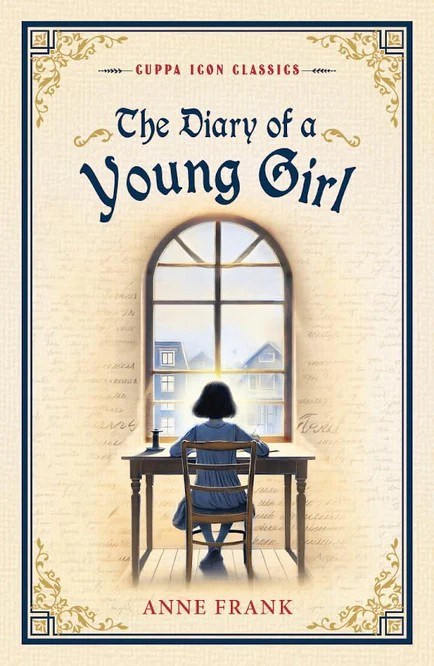
Click to enlarge
The Diary of a Young Girl
Tags
In Stock
In stock: 2-5 days delivery
Ask about this book
Not sure if it's right for you?
Ask our assistant anything about The Diary of a Young Girl.
Answers are AI-generated from this book's details and may not be perfect.
The Diary of a Young Girl stands as one of the most intimate, harrowing, and inspiring testimonies from the Holocaust. It is the voice of Anne Frank, a spirited Jewish girl who fled to Amsterdam with her family to escape Nazi persecution. When Germany invaded the Netherlands in 1940, Anne's world shrank. On her thirteenth birthday, June 12, 1942, she received a red-and-white-checkered autograph book that became her diary. Just weeks later, the Frank family went into hiding in a secret annex behind her father Otto's office at Prinsengracht 263. For twenty-five months, Anne recorded the claustrophobic existence of the eight people hiding there, along with her inner landscape of dreams, fears, frustrations, and hopes.
The diary opens with Anne as a bright, chatty teenager who chafes at adult authority and yearns for friendship. She writes about her mother Edith, her older sister Margot, and her beloved father Otto. Soon the van Pels family (whom Anne calls van Daan) and dentist Fritz Pfeffer (Dussel) join them. Anne captures daily tensions, petty quarrels, terror of discovery, and small joys with astonishing vividness. She explores her sexual awakening and complex feelings for Peter van Pels, symbolizing ordinary desires persisting in extraordinary circumstances.
Beyond the personal, the diary is deeply philosophical. Anne reflects on war, humanity, and identity, famously writing: "I still believe that people are really good at heart." This is not naive optimism but a hard-won conviction born from suffering. The tension between fear of the Nazis and faith in human decency gives the diary extraordinary power. Her writing matures as she reads widely, and she begins to envision a post-war work titled "The Secret Annex." This literary ambition makes the diary a crafted narrative wrestling with existence.
Historically, the diary chronicles life under Nazi occupation. Anne reports news from the radio, discusses the plight of Dutch Jews, and records friends who are deported. She captures air raids, food shortages, and the constant threat of betrayal. That betrayal came on August 4, 1944, when the annex was raided and all eight occupants arrested. Anne and Margot were sent to Auschwitz and later Bergen-Belsen, where both died of typhus in March 1945, weeks before liberation. Only Otto Frank survived. He retrieved the diary from Miep Gies and fulfilled Anne's wish to see it published. The diary first appeared in Dutch in 1947 as "Het Achterhuis."
Since then, The Diary of a Young Girl has been translated into over 70 languages, selling tens of millions of copies worldwide. It is required reading in many schools, though it has faced censorship. Its power lies in both historical witness and timeless exploration of adolescence, identity, and hope. Anne's voice remains fresh as she struggles with her mother, her body, her sexuality, and her search for purpose. She asks urgent questions: What does it mean to be good? How do we maintain faith in the face of brutality? What is the role of writing in preserving memory and asserting humanity?
Themes of prejudice, persecution, and the fragility of civilization run throughout. Anne's story is a stark reminder of unchecked hatred's consequences, but also a celebration of the courage to remain open-hearted. The diary embodies the spirit of democracy, tolerance, and the infinite worth of every individual. In an age of rising nationalism, Anne's words challenge readers to examine biases and choose empathy over indifference.
The diary's mood shifts from lighthearted early entries, full of whimsy and sarcasm, to more somber, introspective passages in the final year. As Anne matures, her writing gains a poetic quality. She contemplates a better world, the joy of nature glimpsed through a crack in the window, and the peace she finds in writing. This emotional arc makes the diary a story of transformation. Readers come to love Anne, grieve her loss, and carry her legacy forward.
For Sri Lankan readers who love meaningful stories, The Diary of a Young Girl offers a profound encounter with the Holocaust on a human scale. It is a mirror for universal challenges: growing up, finding one's voice, and standing up to injustice. Bookolog, Sri Lanka's premier online bookstore, is proud to offer this definitive edition. It includes the complete, unexpurgated text as Anne originally wrote it, with an introduction contextualizing the diary, photographs of the Frank family and the Secret Annex, and a postscript detailing the diarists' fate. Ordering from Bookolog ensures fast delivery, secure payment, and support for local enterprise spreading the love of reading. Anne Frank's voice, once hidden in an attic, now speaks to the world. Let it speak to you.
Key Takeaways
- Anne's diary reminds us that even in the darkest times, a young girl's voice can shine with hope and resilience.
- The uncensored thoughts of Anne Frank provide a deeply personal glimpse into the fear and bravery of hiding during war.
- Readers will be moved by Anne's evolving maturity and her unwavering belief in the goodness of people.
- This diary serves as a powerful reminder of the human cost of hatred and the importance of tolerance.
- Experiencing the everyday struggles of the Secret Annex through Anne's eyes makes history feel immediate and real.
Customer feedback
Reviews & Service Ratings
See what readers say about this book and our service.
Service rating
0.0/5
Please sign in to leave a review and rate our service.
No reviews yet. Be the first to rate this book and our service.
More from Anne Frank
View All
You Might Also Like
Browse All



Products You May Like
Shop All



Bookolatha
Online · Bookolog assistant
Chat history
This chat stays available while you browse.
Log in to save and revisit multiple conversations.
Log in →Bookolatha is grounded in our catalogue and store info. Answers may not be perfect.