 Ask Bookolatha
Click to enlarge
Gulliver's Travels
Tags
In Stock
In stock: 2-5 days delivery
Ask about this book
Not sure if it's right for you?
Ask our assistant anything about Gulliver's Travels.
Answers are AI-generated from this book's details and may not be perfect.
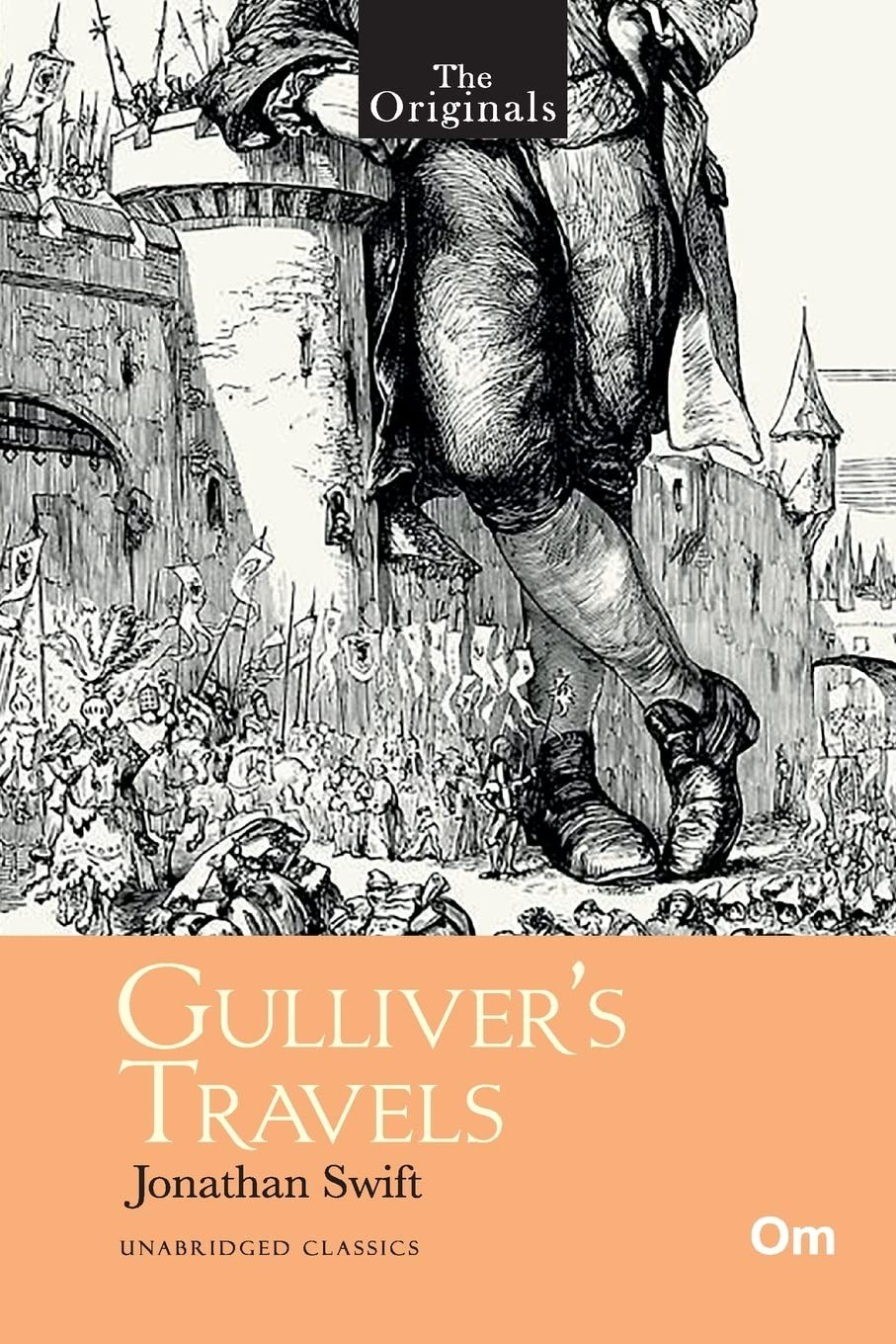
Gulliver's Travels, written by Jonathan Swift and first published in 1726, is a classic work of satire that has captivated readers for centuries. The novel is structured as a travelogue, recounting the adventures of Lemuel Gulliver, a ship's surgeon who finds himself in extraordinary lands after a series of mishaps at sea.
Part I: A Voyage to Lilliput - Gulliver is shipwrecked and washed ashore on the island of Lilliput, where the inhabitants are only six inches tall. At first, the Lilliputians are terrified of the giant 'Man-Mountain,' but they soon put him to use in their petty conflicts, such as the war with the neighboring island of Blefuscu over the correct way to break an egg. Swift uses this minuscule world to satirize the triviality of political and religious disputes in his own society, particularly the feuds between England and France, and the conflict between Catholics and Protestants.
Part II: A Voyage to Brobdingnag - In stark contrast, Gulliver next lands in Brobdingnag, a land of giants where he is the miniature being. Here, the king of Brobdingnag examines Gulliver's accounts of European society and is horrified by the corruption, greed, and violence that Gulliver describes. Swift turns the tables on human pride by having a giant king dismiss the English as 'the most pernicious race of little odious vermin that nature ever suffered to crawl upon the surface of the earth.' This part is a powerful critique of European civilization from an outsider's perspective.
Part III: A Voyage to Laputa, Balnibarbi, Luggnagg, Glubbdubdrib, and Japan - This section is a series of visits to different islands, each satirizing a different aspect of human folly. Laputa is a floating island inhabited by philosophers and scientists who are so absorbed in abstract thought that they need servants to flap them on the mouth and ears to rouse them from their musings. The Academy of Lagado in Balnibarbi mocks the Royal Society and the excesses of the scientific revolution, with projects like extracting sunbeams from cucumbers. In Glubbdubdrib, Gulliver meets historical figures and discovers how history is distorted. In Luggnagg, he encounters the Struldbruggs, who are immortal but suffer eternal aging, a commentary on the vanity of wishing for eternal life.
Part IV: A Voyage to the Country of the Houyhnhnms - Perhaps the most controversial part, Gulliver arrives in a land ruled by rational horses called Houyhnhnms. The Yahoos, human-like creatures, are filthy, brutish, and irrational. Gulliver comes to admire the Houyhnhnms and despise his own kind, ultimately becoming a misanthrope. Swift uses this to question what it means to be human, and to satirize the Enlightenment's faith in reason. The Houyhnhnms represent pure reason, but their cold rationality lacks compassion, while the Yahoos represent base human instincts. Gulliver's journey leaves him disillusioned with humanity.
Overall, Gulliver's Travels is not just a children's adventure story (though it is often abridged for younger readers) but a biting satire on politics, science, religion, and human nature. Swift's sharp wit and dark humor make it a timeless work that continues to resonate. The book is written in a deceptively simple style, but its layers of meaning reward careful reading. It is a masterpiece of English literature, and its influence can be seen in countless later works of satire and fantasy.
Beyond the surface narrative, Swift's novel is a profound exploration of perspective and relativity. By changing the size of Gulliver relative to his surroundings, Swift forces the reader to reconsider what is normal. In Lilliput, Gulliver is a giant among tiny people; in Brobdingnag, he is a tiny man among giants. This shift in scale highlights the relativity of human values and judgments. What is considered great or small in one context can be reversed in another, a lesson about humility and cultural arrogance.
The satire in Gulliver's Travels is often savage. Swift does not spare any institution from his critique. The law, medicine, politics, and even the monarchy are all subjected to ridicule. The Lilliputian emperor's ambition to conquer Blefuscu is a direct parody of the petty wars waged by European monarchs. The philosophers of Laputa are so lost in their speculations that they are useless to society, a jab at the impracticality of certain intellectual pursuits. The scientists of Lagado propose absurd experiments that waste resources, reflecting Swift's skepticism of the new science.
Swift also uses the character of Gulliver to explore psychological transformation. Gulliver begins as a typical English gentleman, proud of his country and its achievements. But as he encounters different societies, his views are challenged. By the end, he is a changed man, unable to even stand the smell of his own family, preferring the company of horses. This extreme reaction is Swift's commentary on the difficulty of maintaining a balanced perspective after seeing the worst of humanity.
The book's structure as a travel narrative allows Swift to juxtapose different social systems. The Houyhnhnms live in a utopia of reason, but their society lacks emotion, art, and love. The Yahoos represent the opposite extreme. Neither is ideal, and Swift seems to suggest that humanity is caught somewhere in between, capable of reason but often driven by passion.
Modern readers may find the last part particularly unsettling, with its misanthropic tone. However, Swift's intent was to shock and provoke thought. He was a satirist who used exaggeration to highlight flaws. While some interpret his view as pessimistic, others see a call for reform. The book ends with Gulliver's acceptance of his own flawed humanity, though he remains disillusioned.
In terms of literary style, Swift employs a matter-of-fact, journalistic tone that contrasts sharply with the fantastic events. This deadpan delivery makes the satire even more effective. The reader is drawn into Gulliver's world and only gradually realizes the underlying mockery. Swift also uses invented languages and customs, adding depth to his fictional worlds.
Gulliver's Travels has been adapted into numerous films, TV series, and stage plays. It remains a staple of literature courses worldwide. Its themes of power, governance, and human nature are as relevant today as they were in the 18th century. Whether read as an adventure story or a philosophical treatise, it offers something for every reader.
Key Takeaways
- Marvel at Swift's sharp satirical wit as Gulliver encounters the petty politics of the tiny Lilliputians.
- Reflect on human vanity when Gulliver becomes a giant among the tiny people of Lilliput.
- Consider the absurdity of scientific progress through the floating island of Laputa and its impractical scholars.
- Explore the contrast between the rational Houyhnhnms and the savage human-like Yahoos to question humanity.
- Appreciate why Gulliver's Travels remains a timeless critique of society, politics, and human nature.
Customer feedback
Reviews & Service Ratings
See what readers say about this book and our service.
Service rating
0.0/5
Please sign in to leave a review and rate our service.
No reviews yet. Be the first to rate this book and our service.
You Might Also Like
Browse All






Products You May Like
Shop All




Bookolatha
Online · Bookolog assistant
Bookolatha is grounded in our catalogue and store info. Answers may not be perfect.