
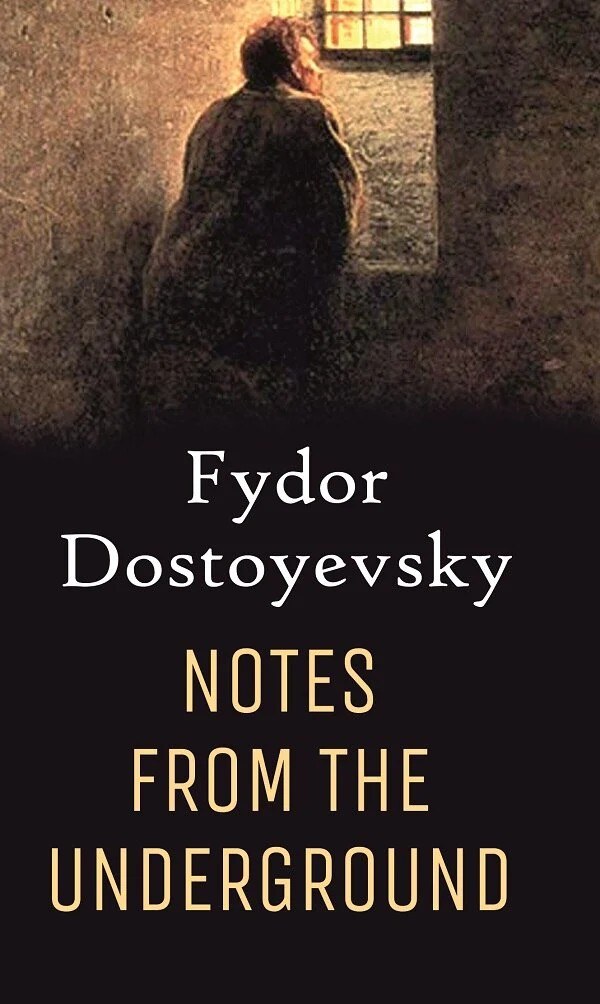
Click to enlarge
Notes from the Underground
Tags
Pre-Order
Pre-order: 2-3 months delivery time
Ask about this book
Not sure if it's right for you?
Ask our assistant anything about Notes from the Underground.
Answers are AI-generated from this book's details and may not be perfect.
Notes from the Underground is a landmark work by Fyodor Dostoevsky, often hailed as one of the first existentialist novels ever written. Published in 1864, it presents the confessions of a bitter, isolated, and hyper-conscious man living in the margins of St. Petersburg society. The novel is structured in two distinct parts: a philosophical monologue that lays out the underground man's worldview, and a narrative titled "A Propos of the Wet Snow" that dramatizes his humiliating interactions with others. This duality makes the book both a penetrating critique of rationalist ideology and a visceral exploration of human psychology.
In Part I, the underground man launches a furious attack on the deterministic and utilitarian philosophies of his era, particularly those espoused in Nikolai Chernyshevsky's What Is to Be Done? He rejects the idea that human beings act purely out of rational self-interest, arguing instead that people cherish their own free will above all else, even when it leads to suffering, chaos, and self-destruction. He mocks the notion of a perfect society built on reason, calling it a "Crystal Palace" where human nature would be flattened into predictable patterns. For the underground man, the irrational and capricious aspects of consciousness are not flaws but the very essence of being human. His rant is laced with sarcasm, self-loathing, and a perverse pride in his own degradation.
The underground man himself is a retired civil servant in his forties, living in a squalid apartment. He is highly intelligent but paralyzed by what he calls "hyper-consciousness" - an overabundance of self-awareness that prevents him from acting decisively. He describes himself as spiteful, envious, and filled with a hatred that he cannot fully explain. He takes morbid pleasure in his own pain, and his contradictions are endless: he rails against society yet craves its approval; he denounces romantic ideals yet yearns for genuine connection. Dostoevsky presents him as a case study in the dark complexities of the human psyche, a figure who anticipates many of the insights of modern psychology.
Part II brings these philosophical ideas into stark, painful reality through a series of episodes from the underground man's past. The first involves a confrontation with an officer in a billiard hall, where the underground man is humiliated and later seeks petty revenge by refusing to step aside in the street. The second episode describes a dinner party with former schoolmates who he despises, yet whom he desperately wants to impress. His behavior there is awkward, pathetic, and mean-spirited, culminating in a speech that exposes all his bitterness and resentment. These scenes reveal how his intellectual posturing crumbles in the face of social reality.
The most powerful and tragic encounter is with Liza, a young prostitute he meets at a brothel. He lectures her on morality, urging her to escape her life and embrace a respectable existence. His words are eloquent, even inspiring, and Liza responds with genuine emotion and a desire to change. But later, when she comes to his apartment hoping for kindness, the underground man humiliates her cruelly, revealing his own inability to love or connect. He pays her money in a final act of spite, and she leaves in tears. This episode distills the novel's core themes: the gap between intellectual ideals and human frailty, the pain of self-awareness, and the destructive power of alienation.
Dostoevsky wrote Notes from the Underground as a direct response to the rationalist socialist movements gaining influence in 1860s Russia. Chernyshevsky's utilitarian vision of a society where people act in enlightened self-interest seemed to Dostoevsky a dangerous delusion. The underground man's rebellion is a defense of humanity's irrational, emotional, and unpredictable nature. The novel argues that any system that denies these fundamental aspects of being will ultimately lead to oppression and despair. This philosophical depth has made the book a cornerstone of existentialist thought, influencing thinkers such as Friedrich Nietzsche, Jean-Paul Sartre, and Albert Camus.
The novel also anticipates many developments in literature and psychology. Its confessional, stream-of-consciousness style broke new ground and paved the way for writers like James Joyce and Virginia Woolf. The underground man's self-cancelling arguments and shifting tones mirror the chaotic workings of the human mind. Freudian and Jungian concepts of the unconscious, repression, and the shadow self find vivid expression in his tortured monologue. The book remains a profound meditation on the nature of freedom and the limits of reason.
The mood of Notes from the Underground is darkly ironic and deeply unsettling. The underground man's voice is both repellent and strangely compelling, forcing readers to confront uncomfortable truths about themselves and their society. Dostoevsky uses harsh humor, rhetorical questions, and sudden tonal shifts to create a sense of intimacy and discomfort. The narrative is not a comfortable read but an essential one, a mirror held up to the contradictions that define the human condition.
For modern readers, this novel offers timeless insights into alienation, the perils of excessive rationality, and the struggle for authentic identity. In an age of increasing digital surveillance, social conformity, and technological control, the underground man's defiance takes on new urgency. Readers interested in philosophy, psychology, Russian literature, or classic novels will find here a challenging and rewarding experience. It is a book that rewards multiple readings, revealing new layers of meaning each time.
At Bookolog in Sri Lanka, we are proud to offer this masterpiece to discerning readers. Whether you are building a personal library or seeking a provocative gift, Notes from the Underground is an essential addition. Its exploration of free will, suffering, and the irrational self resonates across cultures and eras. Order your copy today and delve into one of the most influential works of world literature. The underground man awaits you with his bitter wisdom and his relentless questioning.
Key Takeaways
- Reflect on how the underground man's rejection of rational egoism mirrors modern critiques of hyper-rationality and social conformity.
- Understand the psychology of spite and self-deception as universal human traits that sabotage our own best interests.
- Explore the tension between free will and deterministic rationality, and question whether reason alone can lead to happiness.
- Recognize the critique of utopianism and the Crystal Palace as symbols of imposed order that threatens authentic human freedom.
- Appreciate Dostoevsky's raw, confessional narrative style that predates existentialism and reveals the contradictions within us all.
Customer feedback
Reviews & Service Ratings
See what readers say about this book and our service.
Service rating
0.0/5
Please sign in to leave a review and rate our service.
No reviews yet. Be the first to rate this book and our service.
More from Fyodor Dostoevsky
View All

You Might Also Like
Browse All


Products You May Like
Shop All




Bookolatha
Online · Bookolog assistant
Chat history
This chat stays available while you browse.
Log in to save and revisit multiple conversations.
Log in →Bookolatha is grounded in our catalogue and store info. Answers may not be perfect.