
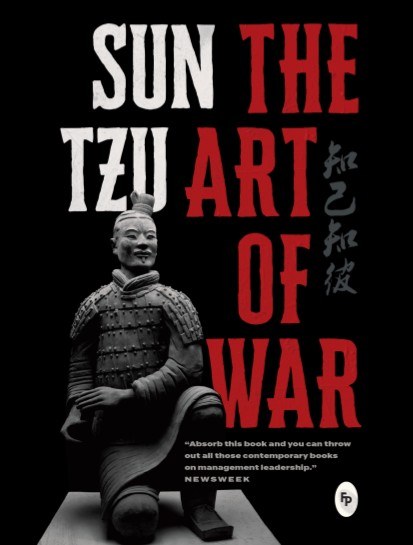
Click to enlarge
The Art of War
Tags
In Stock
In stock: 2-5 days delivery
Ask about this book
Not sure if it's right for you?
Ask our assistant anything about The Art of War.
Answers are AI-generated from this book's details and may not be perfect.
The Art of War by Sun Tzu is one of the most influential and enduring works on military strategy ever written. Composed over 2,500 years ago, this ancient Chinese treatise has transcended its original context to become a foundational text for leaders, thinkers, and strategists in fields as diverse as business, sports, law, and personal development. Its core principles, distilled into 13 concise chapters, offer timeless wisdom on how to achieve victory without unnecessary conflict, how to outmaneuver opponents, and how to lead with clarity and discipline.
The book begins by emphasizing the importance of careful planning and deliberation. Sun Tzu famously states: "The supreme art of war is to subdue the enemy without fighting." This central idea permeates the entire text, advocating for strategies that avoid unnecessary bloodshed and instead rely on intelligence, deception, and positioning. Each chapter covers a specific aspect of warfare: laying plans, waging war, attack by stratagem, tactical dispositions, energy, weak and strong points, maneuvering, variation in tactics, the army on the march, terrain, the nine situations, the attack by fire, and the use of spies.
Key themes include the importance of knowing oneself and one's enemy: "If you know the enemy and know yourself, you need not fear the result of a hundred battles." This principle extends far beyond the battlefield, encouraging readers to assess their own strengths and weaknesses while understanding those of their competitors or adversaries. Sun Tzu also emphasizes flexibility and adaptability, warning against rigid adherence to plans and encouraging leaders to adapt to changing circumstances.
Deception and surprise are central to Sun Tzu's philosophy. He advises: "All warfare is based on deception. Hence, when able to attack, we must seem unable; when using our forces, we must seem inactive; when we are near, we must make the enemy believe we are far; when far, we must make him believe we are near." This emphasis on misdirection and psychological warfare has made the text a favorite among military commanders, business negotiators, and even sports coaches.
Leadership and discipline are other critical elements. Sun Tzu describes the ideal general as one who is wise, sincere, benevolent, courageous, and strict. He stresses the importance of maintaining order, rewarding merit, and punishing failure. At the same time, he cautions against micromanagement, advising leaders to trust their subordinates and delegate effectively.
Historical context adds depth to the work. The Art of War was written during a period of intense conflict in ancient China, the Warring States period, when feudal lords vied for control. Sun Tzu's insights were likely shaped by his own military experience and the strategic lessons of the era. The text was widely studied by Chinese generals and eventually spread to Japan, Korea, and later to the Western world. Today, it is required reading at military academies and business schools alike.
Modern relevance is undeniable. Business leaders apply Sun Tzu's strategies to competitive markets, using concepts like positioning, timing, and intelligence to gain advantage. Sports teams study his tactics to outplay opponents. Even individuals find value in his advice on handling conflict, negotiating, and achieving goals. The book's enduring popularity is a testament to its universal truths.
This edition presents the classic translation with clear formatting and explanatory notes, making it accessible to modern readers. Whether you are a CEO, a soldier, a student, or someone seeking personal growth, The Art of War offers a wealth of practical wisdom that remains as relevant today as it was centuries ago.
In summary, The Art of War is not merely a military manual but a profound philosophical text on strategy, leadership, and human nature. Its lessons on overcoming obstacles, achieving victory with minimal conflict, and understanding the dynamics of competition are invaluable.
Key Takeaways
- Understand the importance of strategic thinking in both warfare and daily life with Sun Tzu's timeless principles.
- Learn how to avoid unnecessary conflicts by knowing when to fight and when to retreat for maximum advantage.
- Gain insight into the value of deception and surprise in achieving victory over opponents in any arena.
- Discover how to leverage your strengths and exploit your enemy's weaknesses through careful observation and planning.
- Apply timeless principles of leadership and discipline to modern challenges, from business to personal growth.
Customer feedback
Reviews & Service Ratings
See what readers say about this book and our service.
Service rating
0.0/5
Please sign in to leave a review and rate our service.
No reviews yet. Be the first to rate this book and our service.
You Might Also Like
Browse All


Products You May Like
Shop All




Bookolatha
Online · Bookolog assistant
Bookolatha is grounded in our catalogue and store info. Answers may not be perfect.