
Click to enlarge
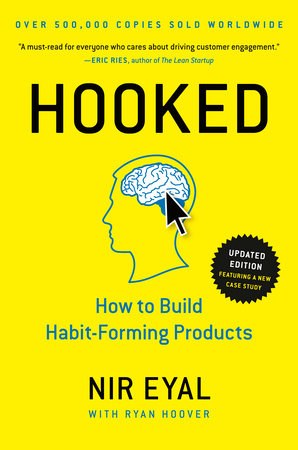
Hooked: How to Build Habit-Forming Products
Tags
Out of Stock
Currently unavailable
Currently unavailable: let us help you find it
Ask about this book
Not sure if it's right for you?
Ask our assistant anything about Hooked: How to Build Habit-Forming Products.
Answers are AI-generated from this book's details and may not be perfect.
In a world saturated with distractions, the ability to create products that users return to again and again is the ultimate competitive advantage. Hooked: How to Build Habit-Forming Products by Nir Eyal decodes the psychology behind the products we cannot put down. Drawing on years of research at the intersection of technology and behavioral science, Eyal introduces the Hook Model, a four-step framework that explains how companies like Facebook, Twitter, Pinterest, and Instagram have woven their services into daily life. The model is not about addiction; it is a guide for designing experiences that solve real problems and create lasting value.
The book opens with a fundamental question: why do some products form strong habits while others fail? Eyal argues that habit-forming products are engineered through a deep understanding of human behavior. The Hook Model provides a systematic approach, starting with the Trigger. Triggers are the cues that prompt action, either external, like a notification, or internal, such as boredom or loneliness. Successful products become linked to internal triggers, so users turn to them automatically when experiencing specific emotions. For example, checking Instagram when feeling lonely or Google when curious. The key is to understand users' internal discomforts and design products that offer relief.
The second step is Action. After a trigger, the user must perform a behavior. Drawing on Dr. BJ Fogg's behavior model (B=MAT), Eyal explains that behavior requires motivation, ability, and a trigger. For a product to be habit-forming, the required action must be as simple as possible. This means reducing friction, streamlining interfaces, and removing barriers. Examples include Twitter's 140-character limit, Instagram's one-tap photo sharing, and Google's clean homepage. Simplifying the action is often more effective than boosting motivation, because simplicity is constant while motivation fluctuates.
The third step, Variable Reward, is the most fascinating. Human brains are wired to seek rewards, but predictable rewards become boring. Variable rewards trigger dopamine, the neurotransmitter associated with anticipation and desire. Eyal identifies three types: rewards of the tribe (social gratification), rewards of the hunt (material resources or information), and rewards of the self (feelings of mastery or accomplishment). Products like Facebook use all three: the tribe (friend updates), the hunt (discovering new content), and the self (curating a profile). By injecting uncertainty, companies keep users engaged and coming back.
The final step is Investment. Here, the user puts something into the product, such as time, data, effort, social capital, or money. Investment increases the likelihood of future triggers because it makes the product more valuable over time. When you follow people on Twitter, the platform learns your interests; when you pin items on Pinterest, you create a personalized collection. Investment can be psychological: naming a plant in a game or curating a playlist creates a sense of ownership. This sets up the hook for the next cycle, strengthening the habit loop with repeated use.
Beyond mechanics, Eyal addresses the ethics of habit design with the Manipulation Matrix, which asks two questions: does the product improve the user's life, and does the maker use it themselves? Products that pass both are facilitators creating win-win relationships; those that fail are manipulators. Eyal challenges designers to build products users would freely choose, aligning with their long-term well-being, such as learning a language, staying fit, or managing finances.
The book is rich with case studies: Pinterest's endless scroll as a variable reward, the red notification dot as an external trigger, and Slack's investment through message threading. Each chapter ends with actionable exercises, though the full value emerges when applying the framework to your own ideas. The audience is broad: startup founders will find a blueprint for product-market fit; product managers can audit features; marketers understand psychological triggers; even educators and health professionals use the Hook Model for behavior change. Written in a clear, engaging style, it has been praised by industry leaders and academics.
Whether you are building an app, a web service, hardware, or even a physical habit like running, the principles in Hooked apply. The book offers a disciplined framework for understanding why people form habits and how to design ethically for behavior change. Master the Hook Model, and you can create products that become part of users' daily routines, delivering consistent value without manipulation.
For readers in Sri Lanka, these insights are especially relevant in a rapidly digitizing economy. As local startups compete for attention, understanding habit design can be the difference between a forgotten app and a beloved platform. Bookolog is proud to offer this essential guide to product builders across the island. Whether you are in Colombo, Kandy, or anywhere in between, order Hooked: How to Build Habit-Forming Products by Nir Eyal and have it delivered to your doorstep. Dive into the psychology of habit and start building products people will use for years to come.
Key Takeaways
- Understand the four-step Hook Model to design products that form strong user habits.
- Learn how triggers, both external and internal, prompt user actions effectively.
- Discover the power of variable rewards to keep users engaged and coming back.
- Implement the investment phase to increase user commitment and product value over time.
- Apply ethical considerations when building habit-forming products for lasting positive impact.
Customer feedback
Reviews & Service Ratings
See what readers say about this book and our service.
Service rating
0.0/5
Please sign in to leave a review and rate our service.
No reviews yet. Be the first to rate this book and our service.
You Might Also Like
Browse All






Products You May Like
Shop All




Bookolatha
Online · Bookolog assistant
Chat history
This chat stays available while you browse.
Log in to save and revisit multiple conversations.
Log in →Bookolatha is grounded in our catalogue and store info. Answers may not be perfect.